When thinking about marketing objectives, most think the most important is making money. Which that goal is super important in order to keep any business running. But it goes a lot deeper than that. Usually when you read anything about marketing objectives it always ties back into the word SMART, but that doesn’t mean what you think SMART stands for Specific, Measurable, Achievable, Relevant and Time based. For any business when it comes to marketing you are not just going to throw some idea and money at the wind and see what sticks. No you are going to look into metrics and data to see when a product should be launched, when to release that product to the consumers and how long to keep it out there before seeing positive or negative results.
The problem is often when we have a strategy in mind and create SMART marketing objectives to run it, that strategy doesn’t focus on the area of the business that actually needs focusing. There will never be a shortage of things to work on, so prioritizing work that will actually make an impact on the business is key. That’s why working on objectives and your digital strategy at the same time is important — they have to play off each other (Coelho, 2021). They said it best, your ideas and objectives have to play off each other.
Look for example at car makers. When you buy a new car it does not come out in that current year, it is actually released toward the end of the previous year. This is so they can market those vehicles early and have people lining up to buy them before they are even produced. This has been done for years and consumers now know when they can get that latest model vehicle to always one up their neighbor or best friend. It is the little things most don’t look at that make marketing for big or small businesses so important and why so many companies have success when launching new products.
When talking about marketing and the power of marketing, you have to look into the channels people have to take to get to their target audience. Most importantly knowing what your target audience is before you start hard core marketing. If you know what demographics you are shooting for will make marketing and creating the right ads in order to get to those target demographics. The two tools that I think will help the most hit my target audience is : Social Media analytics and Website analytics.
Social Media analytics
Looking into what exactly social media analytics are, it is explained that it is a way to look into who is looking at your product on social media. If you have a website and create lets say a Facebook page for your company you can dig into the analytics and see who is looking at your page, what age those people are and if they are female or male. This data can really help when creating new products and hoping to sell those products to certain age ranges. These analytics are an easy way to discover areas you may need to work on and they are generated by the social media page itself. Takes the work out and makes it easier for you and your company on hitting the goals you set. Also with social media the reach is so far and can help get your product out to those target audiences.
Website Analytics
With website analytics are much like social media analytics, you can measure who and what age groups are looking at your site. You can dig into what times of day your traffic may be the highest and what ages are on at that time. With these analytics you can really streamline your products to hit those target demographics. When creating products you want to be able to sell your product and have continue success in other products that you create in the future. These tools are at the tip of your finger tips. Most of these analytics are there and have all the information you need to find the data you need.
When looking into companies that really shot themselves in the foot when it came to being unethical with issues when using SEO/SEM the one that stood out the most to me was BMW in 2006. The company was using what they call “doorway pages” in order to gain more people to their webpage.
Few years back in 2006 BMW German website named BMW.de found itself languishing back in the search engines page results even after using better keywords. BMW now gets frustrated with its website performance where it was doing pretty bad even in the “used cars” segment and it was losing against some of the major and minor websites. The automobile company starts to artificially inflate their inbound links through the use of doorway pages in order to rank higher in the competitive keywords. It should be noted that doorway page is created only for the purpose of redirecting the unsuspecting visitors to the parent page which was BMW site main page ( Bireswar Das, 2015). Even back in 2006, Google wasn’t messing around. BMW.de was promptly blacklisted, receiving a PageRank of 0 as a consequence of the infraction (Erik Devaney, 2014).
Some when it comes to ethical and unethical practices, there are clear differences in them both. With ethical practices people or companies are following the guidelines set or following the social norms in which the standards have been set. In unethical practices people or companies go against the rules that have been set. Its actions that are very unaccepted and can come with punishment.
The benefits of being ethical is consumers trusting your company. Not having a target always on your back when you think you aren’t doing what’s right. You also don’t run a risk of being blacklisted for not following the rules set in place. Being ethical keeps your company honest and safe.
Here we are going to discuss the difference between paid vs. organic strategies. Both of these methods can be used when advertising especially in marketing. Both of these strategies can play a major role when advertising.
Both organic and paid social media landscapes are constantly evolving. New networks rise to prominence (e.g. TikTok), new technology increases user participation and real-time content (e.g. Periscope) and existing networks enhance their platform and product (e.g. Facebook, Twitter, Pinterest and Instagram launching ‘buy’ buttons). Organic reach is also shrinking as the leading networks ramp up their paid social media channels to monetize platform investment (Gurd, 2020).
Paid strategy is when someone pays for the advertising on such platforms like social media. For example if you advertise on lets say Facebook, there are ways you can pay to boost your posts to be able to let more people see your posts.
Organic strategy is a whole different animal when it comes to advertising on such platforms like social media. When it comes to organic advertising you are going to be using the free tools that certain sites provide you. If making a post for your business on Facebook you can create that post and share that post and totally do that without using any paid advertising.
Depending on how evolved your business may be or what your budget may be when it comes to advertising you could either one of these strategies for your benefit. Lets say you have a side hustle and you do it just for fun and to make some extra money, you are not going to pay for advertising on platforms like Facebook or Instagram. You will most likely use organic advertising because it is free and can still get your products out there to thousands of people.
Over the years digital advertising and marketing has improved and became a more simpler process than it was in years past. Early on when the term digital marketing was used ,people did not know what to expect. The internet at the time was not very widespread or completely developed. In the mid 1990s you saw Yahoo first come around which sparked an interest and then in 1998 Google was launched.
Microsoft launched the MSN search engine and Yahoo brought to the market Yahoo web search. Two years later, the internet bubble burst and all the smaller search engines were either left behind or wiped out leaving more space for the giants in the business. The digital marketing world saw its first steep surge in 2006 when search engine traffic was reported to have grown to about 6.4 billion in a single month. Not one to get left behind, Microsoft put MSN on the backburner and launched Live Search to compete with Google and Yahoo (Monnappa, 2021).
So know here we are in 2021 and what does the future hold for digital advertising and marketing? I will talk about some of the advancements and new technologies that we can see in the next few years.
Chatbots
One implementation of conversational marketing is chatbots. Chatbots leverage AI technology to provide automated human-like messages to web visitors in real-time (Dave, 2021). With Chatbots it gives companies the ability to have questions answered 24/7. I would think Chatbots would have a negative impact on customers experience when most people like to talk to a real person. But, 80% of customers say they have had a positive experience talking to a Chatbot. The industry says that Chatbots will help people spend close to $142 billion dollars in 2022, up from 2.8 billion in 2019.
Video Marketing
Video marketing is one of the most popular marketing and advertising tool in the past few years. When we talk about video marketing, don’t just think of YouTube. There are plenty of ways to drive higher engagement with your video marketing. For instance, you can make a video post or start a live broadcast on Facebook, LinkedIn or Instagram (Dave, 2021). I enjoy watching videos of my favorite items being advertised. Some companies do a great job at creating these videos where even if you do not need that product you are tempted to buy it anyway. When investing into video marketing I feel its the best way to get a return and profit from them.
Influencer Marketing
This type of marketing is when companies hire well known people that customers may trust their word and these companies use these influencers to promote their product. Social media has exploded over the years and more and more celebrities turn to social media to post so their fans can see what they are up to. For influencer marketing to be effective, you don’t always need to work with a huge star or local hero. Search for people with growing audiences on new platforms, and notice how they interact with their followers. Having a small but dedicated audience is more beneficial for your marketing purposes than having a large but disconnected audience. It is also important that your values align with those of the influencer so that your message and mission are appropriately communicated, and you can be confident that you’re both working together to reach the same goal (Lara, 2021). Numbers show that people buy products if they see someone they feel like they have a connection with.
Those are some of the technologies and trends I see making a big splash in the advertising world in the next 5 years. The way marketing has grown and evolved , there is no telling what the future holds.
We all know the company Lowe’s and what Lowes’s does which is a hardware store that provides ways to improve your home. Lowe’s has both a vision and mission statement. First lets look at the vision statement: “we will provide customer-valued solutions with the best prices, products, and services to make Lowe’s the first choice for home improvement.” Having worked for Lowe’s in management I can say that they hold true to this statement by providing really great prices and most of the time great products. I think the product side of things is where Lowe’s may drop the ball in some categories. Yes get a product at a good price from a supplier but when you price that product at a mark up due to wanting to make the most money, but that product gets returned a lot due to it not being made of quality materials. I think that’s where Lowe’s drops the ball in a lot of scenarios. Now switching over to their mission statement: “together, deliver the right home improvement products, with the best service and value, across every channel and community we serve.” Within this statement I would have to say where Lowe’s does not do good at positioning itself is customer service. There are good employees out there that want to help the company/brand do well and there are some that are there to just collect a check. But that just doesn’t go for Lowe’s that is everywhere in retail.
With Lowe’s great prices and community service it does throughout towns, it positions itself over its competition like Home Depot and Menards. Lowe’s will match any price from its competition and do whatever it takes to get the business of its competition’s customers. From it’s start in 1921, Lowe’s has made it a point to make sure the customer comes first over anything else.
One way Lowe’s made a change to focus more on branding was to hire a new marketing vice president. One example of what was done was advertisements that was run on all social media platforms plus teaming up with the National Football League and having ads run on Sundays where millions of people see it. But one of the biggest ways Lowe’s gained ground and passed its competition was a new marketing tactic called the “Bucket Brigade”. Its Bucket Brigade helps communities in need by providing necessary supplies to those affected by natural disasters like the California wildfires. So, as the pandemic started to hit the United States and the country went into lock-down, Marisa Thalberg, Lowe’s newly appointed Executive Vice President, Chief Brand and Marketing Officer, leaned into Lowe’s heritage of being there for communities. Nurturing this core value, Thalberg guided the company into a new marketing strategy that emphasized brand-driven stories in addition to traditional marketing tactics (Veronika Sonsev, 2021). Overall Lowe’s has done good at keeping up with the competition and surpassing most.
Well all of us watch television, surf social media or even listen to some sort of music if its the radio or being streamed. All of us have heard or seen many ads promoting so many companies that are trying to get an edge up on their competition. I have so many companies that I chose to support their brands, and I know this may make me sound like an alcoholic and I’m not at all I just enjoy a cold beverage from time to time to unwind after a long day. The company I am going to talk about their brand positioning is Miller Lite.
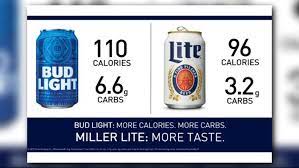
Miller Lite has a been a leader in the beer world for many many years. You walk into any gas station, grocery store and liquor stores you will find that iconic white can with a gold top and blue writing sitting right there on the self with all its competitors. Now Miller Lite’s biggest competition is Bud Light. They are both lower calorie beers that let people not feel as guilty when they consume several of these beverages. The battle between these two giants in the beer world have gone back an forth to who has the better beer and more customers. Miller Lite has made it a point to show that its beer has fewer calories than Bud Light or any other light beer on the market.
Miller Lite does a great job with their ads showing its customers that it is the low calorie beer with great taste. Miller Lite really hits their mark when advertising during sporting events when most beer drinkers are enjoying a cold one while watching their favorite team. They spend a lot of money on these ads because they know the potential return to maintain current customers and potentially being able to get new customers is there. They also do a great job at putting up displays in stores that grab your attention and even with a can or bottle that has a simple logo on it, that simple logo still grabs you with its clean low key look. Miller Lite keeps it simple and lets the great taste of the beer do all the work.
At the end of the day I do not think Miller Lite misses the mark with their brand positioning. Pricing is right at a good point with its competition, Its logo is clean and simple and they put it in stores placed where customers will take notice. The stakeholders for Miller Lite have to be happy with the product that is on the shelves for their customers. The battle will always be there between Miller Lite and all the other light beers on the market and one day one may be on top and the next may be another. That’s just the nature of the beast in the beer industry and Miller Lite has to continue to prove themselves over and over and give the best beer they can produce to keep proving how great of a beer it is.
We are talking about what AT&T did that was illegal and caused them to have to refund several millions of dollars to customers. What AT&T was charged with was what is called “mobile cramming”. This is where third party charges were being added to customers bills without them knowing about it. This settlement that AT&T had to pay out was the most ever by any company.
As a former AT&T customers and knowing the struggle I had with my bill always rising and having the back and forth with the company, I can only imagine what the customers caught up in this are feelings. How can you trust AT&T ever again and not know if they would do this again. This “mobile cramming” is a huge break of trust and now will make everyone want to look at their bills closer to make sure they are not getting ripped off. This could cause a huge fallout and make consumers switch to other carriers.
The company could face huge audits from the Federal Trade Commission due to these charges. No one could trust them to not do this again due to AT&T potentially getting kick backs from these other companies that were putting charges onto the consumers bills. The fines could get even bigger and bigger over time if the company is caught again with possible suspensions to higher up executives being fined or fired.
After all this happening it shows that other marketers should for sure disclaim any and all to the consumers. Even if there are potential extra charges like if someone downloads a ringtone or some sort of music for there phone, these need to be put in the writing so if the customer did download anything they know that there could be charges and it will fall on them and not the company. Since AT&T did not disclaim this, this ended up leading to a lawsuit and a huge payout. Customers have to know what could they be charged or signed up. Disclaimers could be a huge saving grace and a marketing team has to make sure they have those in place so lawsuits do not happen.
In todays world the amount of individuals that own mobile devices like phones and tablets are a lot. According to the Pew Research Center, 96% of Americans own a cellphone of some sort. And in 2019, the share of Americans who own a smartphone registered at 81% — that’s up 46% from 2011 (Sherry Moats, 2020). With that many Americans owning a smartphone the amount of mobile marketing can be endless. The amount of time I personally spend on my own smartphone and the number of ads I come across on different social media platforms I can only imagine how much it actually covers when so many people own smartphones and see the same ads I do or even more that I do not see on a daily basis. That being said how many people including myself buy products from those ads, and at the end of the day I know I have bought a few products from ads that have popped up on my feed and if I do not buy it right away I will go to the website to do some more research which leads to more traffic for that business on their site and will lead to purchases or seeing what other products they have to offer. We all use our smartphones as a form of entertainment, and boredom can create interest in something new. And as a seller with online offerings, you are able to fill a consumer need (Sherry Moats, 2020).
With over five billion unique users on mobile devices, marketing to people with smartphones can increase your brand’s awareness and improve your conversion rates. The numbers show how significant mobile device usage has become:
Mobile ad spending accounts for 72% of the digital advertisements purchased in the U.S.
Digital marketers spend over half of their budget on mobile advertisements.
When used as part of a multichannel marketing approach, mobile marketing can lead to more sales.
Smartphone use encourages 70% of people to make purchases in store after using their phones to get more information about a product or service.
More than 90% of businesses that use an advanced personalization strategy saw revenue growth in 2018.
Mobile devices are responsible for over 40% of the transactions that people complete online (Campaign Monitor, 2020).
The numbers do not lie when it comes to how mobile marketing can increase sales for all businesses. Lets take craft breweries for example. When most breweries start up they do not have a lot of staff and especially someone who just runs their marketing. So, getting onto social media like Facebook and Instagram and making a post with a picture of a beer they make or some clothing they have or as most people say “swag”. By doing something that simple can lead to so many new customers and foot traffic into their brewery. Mobile marketing gives businesses so many opportunities do be able to reach millions of people and bring attention to what you are selling.
I think social media marketing is very important and can really add marketing success to any business, and can provide a chance to try new things for fewer cost than other traditional marketing outlets. In this blog I am looking at which social media outlet is better, Pinterest or Twitter.
I think for a business they both can play an important role on the marketing side of the business. Pinterest in my opinion is the better of the two when it comes to advertising your business. With Pinterest you can put your products on there. Where Pinterest in more of a DIY social media platform, showing people how to build something or cook a certain recipe. But just like other platforms once you put a product out there you can link it to Pinterest where when some searches something similar it will take you to products your business makes and then can direct you to your website from there. I search a lot of truck parts on Pinterest because I find stuff I don’t find on other sites. I feel like Pinterest is valuable for users because it can hit a more direct demographic you are looking to hit with the products you are selling.
With Twitter I mostly get on to see current events, or sports highlights. I do see some business ads pop up through the feed but usually none of my friends that have small businesses using Twitter as a marketing tool. I think someone could use Twitter post a picture of their product and see if it gets likes or retweets, or you could use Twitter as a poll and ask people to retweet if they like one product and like if they like another product.
So at the end of the day I would chose Pinterest over Twitter to market my business.




 Kyle's Blog